
Showing posts with label Education. Show all posts
Showing posts with label Education. Show all posts

Point - Counterpoint
 I went to a funeral today. The mother of one of our students passed away after a long battle with cancer. It was a beautiful Christian funeral, at which one of her daughters read John Donne's "Holy Sonnet X".
Death, be not proud, though some have called thee
Mighty and dreadful, for thou are not so;
For those whom thou think'st thou dost overthrow
Die not, poor Death, nor yet canst thou kill me.
From rest and sleep, which but thy pictures be,
Much pleasure; then from thee much more must flow,
And soonest our best men with thee do go,
Rest of their bones, and soul's delivery.
Thou'art slave to fate, chance, kings, and desperate men,
And dost with poison, war, and sickness dwell,
And poppy'or charms can make us sleep as well
And better than thy stroke; why swell'st thou then?
One short sleep past, we wake eternally,
And death shall be no more; Death, thou shalt die.
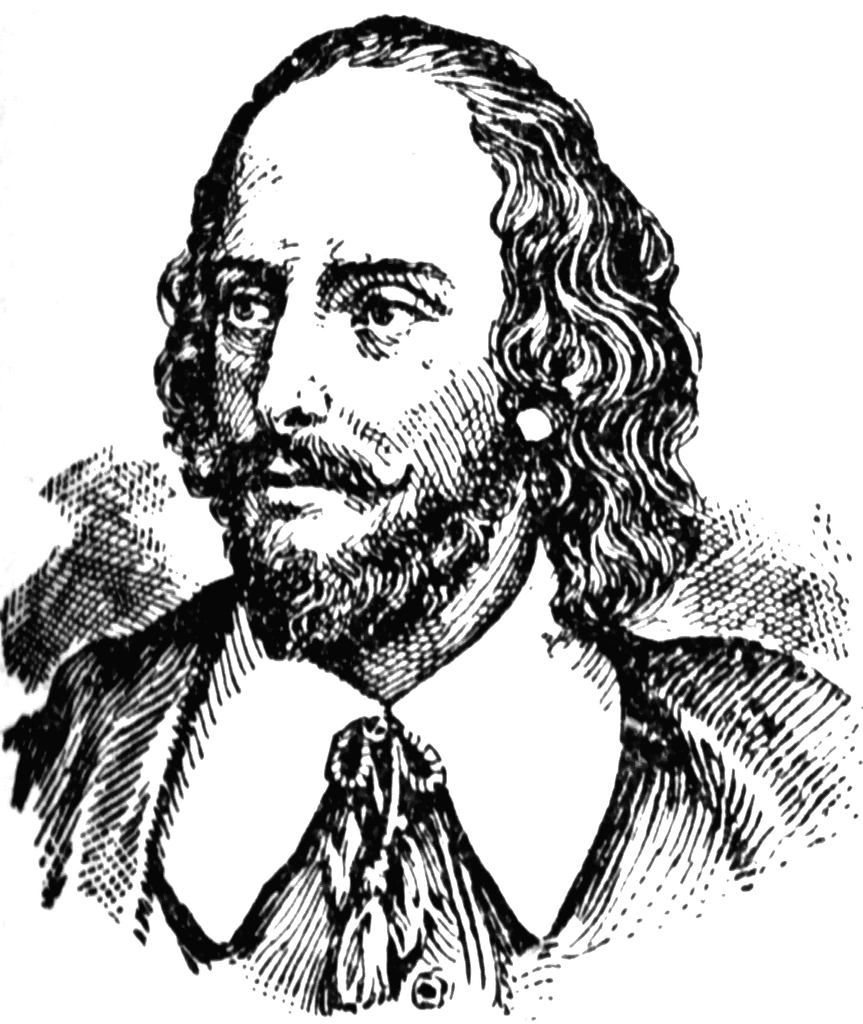 As I was listening to it, I couldn't help hearing for the first time, though I am shocked to say so, the echoes of Hamlet's famous "To be, or not to be?" speech, which I have taught to seniors for over ten years now.
To be, or not to be: that is the question:
Whether 'tis nobler in the mind to suffer
The slings and arrows of outrageous fortune,
Or to take arms against a sea of troubles,
And by opposing end them? To die: to sleep;
No more; and by a sleep to say we end
The heart-ache and the thousand natural shocks
That flesh is heir to, 'tis a consummation
Devoutly to be wish'd. To die, to sleep;
To sleep: perchance to dream: ay, there's the rub;
For in that sleep of death what dreams may come
When we have shuffled off this mortal coil,
Must give us pause: there's the respect
That makes calamity of so long life;
For who would bear the whips and scorns of time,
The oppressor's wrong, the proud man's contumely,
The pangs of despised love, the law's delay,
The insolence of office and the spurns
That patient merit of the unworthy takes,
When he himself might his quietus make
With a bare bodkin? who would fardels bear,
To grunt and sweat under a weary life,
But that the dread of something after death,
The undiscover'd country from whose bourn
No traveller returns, puzzles the will
And makes us rather bear those ills we have
Than fly to others that we know not of?
Thus conscience does make cowards of us all;
And thus the native hue of resolution
Is sicklied o'er with the pale cast of thought,
And enterprises of great pith and moment
With this regard their currents turn awry,
And lose the name of action.
The profundity of Donne's poem was only increased for me by putting it into dialogue with this challenge from Hamlet to the Christian hope beyond the grave. In fact, reading the robustly Christian critique of death that is "Holy Sonnet X" in the context of the deeply humane but pervasively pagan Hamlet, not to mention thinking and feeling my way through this in the context of a real death and real grief, gave me an even greater appreciation for all three.
If I had Twitter...
... I could tell you that I am giving oral exams for the next two days straight.
Gosh I'm going to miss teaching these kids ...
One of my eighth-grader's year-end definition of poetry:
"Poetry is something that exposes the root of beauty - namely love."
Thinking About ...
... the durability of being and the Scholastic associations between substance, time and space.
OK ... I get paid to do this. It's my job.
This "Thinking About..." was from a conversation in my 12th grade Humane Letters class yesterday and the other two sprung out of our faculty seminar discussion of Louis Menand's The Metaphysical Club. So it may not be cooking but I am bringing home the bacon - the Francis Bacon that is. And, honestly, I can hardly believe that I found a way to get paid to do this. What a blessed vocation.
Speaking of cooking ... wonderful homemade French Onion Soup awaited my homecoming last night. Wow!
OK ... I get paid to do this. It's my job.
This "Thinking About..." was from a conversation in my 12th grade Humane Letters class yesterday and the other two sprung out of our faculty seminar discussion of Louis Menand's The Metaphysical Club. So it may not be cooking but I am bringing home the bacon - the Francis Bacon that is. And, honestly, I can hardly believe that I found a way to get paid to do this. What a blessed vocation.
Speaking of cooking ... wonderful homemade French Onion Soup awaited my homecoming last night. Wow!
Quote of the Day 2/22/09
 The older I grow the more I am convinced that there is no education which one can get from books and costly apparatus that is equal to that which can be gotten from contact with great men and women.
Booker T. Washington, Up From Slavery
Homeschool High-Tech
The kids were doing some work in science yesterday with measurements and data. They put cups of boiling, room temperature, and cold tap water outside to see how fast each would freeze. They also made hypotheses as to how long it would take each to freeze.
When they were done recording the data, though, rather than make a chart we decided to work with a spreadsheet! So they learned not only about data and about the behavior of water but also about spreadsheets, data entry, and making charts!
Here are the results. Note that there are two charts here with two distinct keys:

(click the picture for a screen sized version)
When they were done recording the data, though, rather than make a chart we decided to work with a spreadsheet! So they learned not only about data and about the behavior of water but also about spreadsheets, data entry, and making charts!
Here are the results. Note that there are two charts here with two distinct keys:

(click the picture for a screen sized version)
Thinking About ...
... theological aesthetics and sense of wonder anew in light of Josef Pieper's desire to re-integrate intellectus and ratio as articulated in his Leisure, the Basis of Culture.
Thinking About ... Three Types of Boredom ...
... another 22 Words inspired set of distinctions.
Abraham Piper raised the question, "Whose fault is it if you're bored?"
I think I would make the following distinction before answering the question.
You could think of 'boredom' as a simple an emotional state, an emotional state that could arise from any number of complex or interrelated causes. Like anger, boredom in this sense is not be blameworthy in and of itself.
There is another type of boredom, however, that is more deep seated. It's a way of being in the world. Call it 'ennui' if you like. This boredom is a fundamental disposition of the human person towards other people, the Cosmos, and maybe even the Creator. This second type of boredom is certainly blameworthy and, what's worse, potentially deadly to the soul. It is the opposite of openness to being. It is a corrosive evil.
Finally, a third type of boredom might arise simply from living passively in a technological, consumerist, info-tainment based culture. This 'boredom' is neither a blameless emotional state nor a corrosive disposition of the soul but a simple habit, a habit acquired through allowing your interest to be too often spoon fed you. As it becomes more pervasive, it amounts to a failure to rouse oneself from the slumber of being entertained by the World to the responsibility for creative, dynamic engagement in the created Cosmos. It's laziness at best, 'soul sleep' before death at worst.
It seems to me that I should keep this in mind not only for myself but also in my child rearing. What I do with my own boredom and how I handle my children's occasional announcement, "I'm bored," should be shaped by a discerning attitude towards the root and extent of that boredom. Because if these distinctions hold, it would be a grave mistake in every direction to treat all boredom alike.
Abraham Piper raised the question, "Whose fault is it if you're bored?"
I think I would make the following distinction before answering the question.
You could think of 'boredom' as a simple an emotional state, an emotional state that could arise from any number of complex or interrelated causes. Like anger, boredom in this sense is not be blameworthy in and of itself.
There is another type of boredom, however, that is more deep seated. It's a way of being in the world. Call it 'ennui' if you like. This boredom is a fundamental disposition of the human person towards other people, the Cosmos, and maybe even the Creator. This second type of boredom is certainly blameworthy and, what's worse, potentially deadly to the soul. It is the opposite of openness to being. It is a corrosive evil.
Finally, a third type of boredom might arise simply from living passively in a technological, consumerist, info-tainment based culture. This 'boredom' is neither a blameless emotional state nor a corrosive disposition of the soul but a simple habit, a habit acquired through allowing your interest to be too often spoon fed you. As it becomes more pervasive, it amounts to a failure to rouse oneself from the slumber of being entertained by the World to the responsibility for creative, dynamic engagement in the created Cosmos. It's laziness at best, 'soul sleep' before death at worst.
It seems to me that I should keep this in mind not only for myself but also in my child rearing. What I do with my own boredom and how I handle my children's occasional announcement, "I'm bored," should be shaped by a discerning attitude towards the root and extent of that boredom. Because if these distinctions hold, it would be a grave mistake in every direction to treat all boredom alike.
The Emily Side of Life
At the dinner table we were talking about Beth's grave illness and sense that she was preparing to die in Little Women. (The kids are listening to it on tape during car rides.)
Emily says, "Yea, she's 'Knock, knock, knockin on heaven's door.'"
Emily says, "Yea, she's 'Knock, knock, knockin on heaven's door.'"
Thinking about ...
... the difference between wisdom and knowledge, the overwhelming bias towards the latter in an information age.
●Knowledge is not wisdom.
●Though tangentially related, the two cannot be pursued in the same way or at the same time.
●Information is a consumable good; knowledge is a storehouse of consumed information.
●Our age has made information an cheap, attractive, marketable good.
●In the information age, if one wants to pursue wisdom with greater zeal or devotion, he must find a way to turn his energies away from the aquisition and consumption of more and more information.
Thoreau went into the woods to live deliberately.
technoSabbatarianism may only be step one ...

●Knowledge is not wisdom.
●Though tangentially related, the two cannot be pursued in the same way or at the same time.
●Information is a consumable good; knowledge is a storehouse of consumed information.
●Our age has made information an cheap, attractive, marketable good.
●In the information age, if one wants to pursue wisdom with greater zeal or devotion, he must find a way to turn his energies away from the aquisition and consumption of more and more information.
Thoreau went into the woods to live deliberately.
technoSabbatarianism may only be step one ...

Homeschool Trumps Itself
So, looking over my shoulder at the post "Way to go, homeschool girl!" Anna said, "Hey, it's got base 2 math in the back of it."
A Prophetic Link Between Babel and Pentacost
One of my students pointed this out in the context of our discussion of Pentacost as an Anti-Babel.
Zephaniah 3:9 For then I will restore to the peoples a pure language, That they all may call on the name of the Lord, To serve Him with one accord.
Zephaniah 3:9 For then I will restore to the peoples a pure language, That they all may call on the name of the Lord, To serve Him with one accord.
Education and Intellectual Wisdom #1
There was a call for a richer development of the list of skills I wrote should be a part of a true education. I thought it would be best for people to give a variety of examples.
#1 the way to discern the fundamental human questions that lie beneath a text
Any examples of such discernment?
#1 the way to discern the fundamental human questions that lie beneath a text
Any examples of such discernment?
Education and Intellectual Wisdom
Several critical intellectual skills that teachers don't often think to model for their students or even attempt to inculcate:
●the way to discern the fundamental human questions that lie beneath a text
●the way to discern between primary, secondary and tertiary matters and to maintain those distinctions
●the way to listen to the tone of an argument and to take that tone appropriately into account in giving an assessment
●the way to bring aesthetic sensibilities to bear upon any object of inquiry
●the way to attain knowledge through belief and to know what kind of knowledge that is
●the way to practice the “willing suspension of disbelief”
●the way to translate between different authors (i.e Calvin and Aquinas, Locke and Rousseau, or Hegel and Descartes), between different disciplines (i.e philosophy, theology, and poetry), or even between different fields (i.e. sociology and theology, poetry and science, or mathematics and philosophy)
●the way not only to distinguish between the True, the Good and the Beautiful but also to listen to their essential harmony
●the way to convince yourself to care about everything and anything
●the way to adjust even the base of an intellectual structure without toppling the whole structure
●the way to understand, order and direct your emotional responses to texts, authors and ideas
●the way to understand and work with the differences between organic and mechanical systems
●the way to understand the complex interactions between instinct, experience and knowledge
 Any other intellectual skills you wish your teachers would have modeled or attempted to inculcate?
●the way to discern the fundamental human questions that lie beneath a text
●the way to discern between primary, secondary and tertiary matters and to maintain those distinctions
●the way to listen to the tone of an argument and to take that tone appropriately into account in giving an assessment
●the way to bring aesthetic sensibilities to bear upon any object of inquiry
●the way to attain knowledge through belief and to know what kind of knowledge that is
●the way to practice the “willing suspension of disbelief”
●the way to translate between different authors (i.e Calvin and Aquinas, Locke and Rousseau, or Hegel and Descartes), between different disciplines (i.e philosophy, theology, and poetry), or even between different fields (i.e. sociology and theology, poetry and science, or mathematics and philosophy)
●the way not only to distinguish between the True, the Good and the Beautiful but also to listen to their essential harmony
●the way to convince yourself to care about everything and anything
●the way to adjust even the base of an intellectual structure without toppling the whole structure
●the way to understand, order and direct your emotional responses to texts, authors and ideas
●the way to understand and work with the differences between organic and mechanical systems
●the way to understand the complex interactions between instinct, experience and knowledge
Any other intellectual skills you wish your teachers would have modeled or attempted to inculcate?
When Homeschool Goes off Script

Good ol' Nora.
Sometimes when you're learning to read in 100 easy lessons you just carry that initial consonant right on over to the next word.
Integrity Part IV: The Beginning of the End of the Boy That I Knew
On this last day, I want to return to that boy that I knew, the one with all the hang ups about who he was and what he wanted, the one I gave you several snapshots of on Monday.
I want to let you know what happened to him because, he's not that same boy anymore and he's not the same boy because he came to know that God loved him in a way that was deeper, more lasting, and more freeing than the approval he was desperately looking for from his friends, or even from himself, the approval that he had thought would bring him wholeness and integrity. Here's how it happened.
By the time that he was in ninth grade, the boy that I knew was riding pretty high in some ways and doing pretty well at winning that approval he wanted. He did very well in school, he did very well on the football field and on the basketball court and he did very well in the lunchroom. One of his chief skills in that last arena was his quick wit and sharp tongue – something that comes as little surprise to those who still know him. Particularly, this boy that I knew wasn't afraid to go anywhere with a joke, especially a sarcastic one or one that took somebody else down a few notches. In fact, that was probably his best trick.
At the school the boy that I knew attended, they didn't have morning prayer like this. Instead, they used to have a little longer chapel service once a week. This boy that I knew was one of the ones who liked to sit in the back of that chapel and make jokes about the speaker. I suppose some of them were probably even pretty funny. He sure looked like he was having fun, this boy that I knew. And at the very least, the jokes kept him safe from having to take anything seriously.
Once a year they had a whole week where a special speaker came in and they had chapel every day – which was OK as far as the boy that I knew cared, because it mixed things up a bit. And one time they even had basketball player come in.
But this time, this time. Oh my gosh, they got a real dork. He must have been 6'7”. He wore plaid short-sleeve shirts, had a ridiculous mustache and was, worse than all of that, the brother of the boy's English teacher. And he had an autoharp.
How many of you know what an autoharp is? Well, it's just about the uncoolest instrument you could possibly imagine playing in front of a group of high school kids. It's this big board with strings and keys like a piano that you strum like a guitar. What the heck is that??? But he brought his autoharp and he brought his wife, who had a bad haircut, and they sang songs together while he played his autoharp.
This was rich material for the boy that I knew. This was going to be fun, he thought, sitting in the back, sniping from the pews. It was almost too easy. He was so uncool it almost wouldn't be fun to make fun of him. Maybe we should throw tomatoes, the boy that I knew thought.
And then he started out by reading some kind of Christian children's stories – something about sled dogs. The boy that I knew was shocked. This was ridiculous. Laughable. It wasn't even entertaining. “Oh my gosh. Stop talking!” he thought. “Let me out of here, for God's sake. I'm going to go absolutely freaking insane if I have to listen to five more minutes of this!”
But as the week went on, the boy that I knew grew quieter and quieter.
Some of the kids around him started listening and discussing what the man with the autoharp was saying. Discussing it! At lunch! Why??? Some of those people were even guys he played football with. Seniors he respected and whose respect he had thought he wanted. Then the boy himself started to listen. He started to realize that he himself was getting angry, defensive. He wanted to verbally assault the man. He wanted him to leave.
The problem was that that the man with the autoharp started getting into his head, making a weird kind of sense. He began to see that the man with the autoharp probably knew that he was sitting in the back laughing and didn't even care! Didn't even care! How dare he! How dare he not care what the boy that I knew thought of him!
Then the man spoke of the love of God, and he spoke about the brotherhood and courage of those who followed God. He spoke of high school kids he knew who had traded their dead ends for real purposeful action, who were making a difference in their communities, their churches and their schools. He invited everyone to join them, to help change the world.
And suddenly the boy that I knew saw all and knew himself for what he was – sitting in the back row making jokes, tearing down his friends with biting sarcasm to advance his own pride and insecurity, picking on the weak and defenseless. And even worse, he saw himself left out of whatever it was the man in the autoharp was talking about, left out of something he suddenly wanted in on.
At the end of the week, there was a chance for people to come to the microphone and talk about the week. The boy that I knew wanted to get up and say something profound, to tell everyone that they should listen to the man with the autoharp. But when he got to the microphone, all he could say was “I'm sorry.” He couldn't say any more. He just broke down crying. But he was pretty sure everyone knew what he meant.
The life of the boy that I knew didn't change overnight, but it has never been the same either. The boy that I knew turned a corner that week.
And when I have morning prayer next semester, I'll tell you the rest of the story.
I want to let you know what happened to him because, he's not that same boy anymore and he's not the same boy because he came to know that God loved him in a way that was deeper, more lasting, and more freeing than the approval he was desperately looking for from his friends, or even from himself, the approval that he had thought would bring him wholeness and integrity. Here's how it happened.
By the time that he was in ninth grade, the boy that I knew was riding pretty high in some ways and doing pretty well at winning that approval he wanted. He did very well in school, he did very well on the football field and on the basketball court and he did very well in the lunchroom. One of his chief skills in that last arena was his quick wit and sharp tongue – something that comes as little surprise to those who still know him. Particularly, this boy that I knew wasn't afraid to go anywhere with a joke, especially a sarcastic one or one that took somebody else down a few notches. In fact, that was probably his best trick.
At the school the boy that I knew attended, they didn't have morning prayer like this. Instead, they used to have a little longer chapel service once a week. This boy that I knew was one of the ones who liked to sit in the back of that chapel and make jokes about the speaker. I suppose some of them were probably even pretty funny. He sure looked like he was having fun, this boy that I knew. And at the very least, the jokes kept him safe from having to take anything seriously.
Once a year they had a whole week where a special speaker came in and they had chapel every day – which was OK as far as the boy that I knew cared, because it mixed things up a bit. And one time they even had basketball player come in.
But this time, this time. Oh my gosh, they got a real dork. He must have been 6'7”. He wore plaid short-sleeve shirts, had a ridiculous mustache and was, worse than all of that, the brother of the boy's English teacher. And he had an autoharp.
How many of you know what an autoharp is? Well, it's just about the uncoolest instrument you could possibly imagine playing in front of a group of high school kids. It's this big board with strings and keys like a piano that you strum like a guitar. What the heck is that??? But he brought his autoharp and he brought his wife, who had a bad haircut, and they sang songs together while he played his autoharp.
This was rich material for the boy that I knew. This was going to be fun, he thought, sitting in the back, sniping from the pews. It was almost too easy. He was so uncool it almost wouldn't be fun to make fun of him. Maybe we should throw tomatoes, the boy that I knew thought.
And then he started out by reading some kind of Christian children's stories – something about sled dogs. The boy that I knew was shocked. This was ridiculous. Laughable. It wasn't even entertaining. “Oh my gosh. Stop talking!” he thought. “Let me out of here, for God's sake. I'm going to go absolutely freaking insane if I have to listen to five more minutes of this!”
But as the week went on, the boy that I knew grew quieter and quieter.
Some of the kids around him started listening and discussing what the man with the autoharp was saying. Discussing it! At lunch! Why??? Some of those people were even guys he played football with. Seniors he respected and whose respect he had thought he wanted. Then the boy himself started to listen. He started to realize that he himself was getting angry, defensive. He wanted to verbally assault the man. He wanted him to leave.
The problem was that that the man with the autoharp started getting into his head, making a weird kind of sense. He began to see that the man with the autoharp probably knew that he was sitting in the back laughing and didn't even care! Didn't even care! How dare he! How dare he not care what the boy that I knew thought of him!
Then the man spoke of the love of God, and he spoke about the brotherhood and courage of those who followed God. He spoke of high school kids he knew who had traded their dead ends for real purposeful action, who were making a difference in their communities, their churches and their schools. He invited everyone to join them, to help change the world.
And suddenly the boy that I knew saw all and knew himself for what he was – sitting in the back row making jokes, tearing down his friends with biting sarcasm to advance his own pride and insecurity, picking on the weak and defenseless. And even worse, he saw himself left out of whatever it was the man in the autoharp was talking about, left out of something he suddenly wanted in on.
At the end of the week, there was a chance for people to come to the microphone and talk about the week. The boy that I knew wanted to get up and say something profound, to tell everyone that they should listen to the man with the autoharp. But when he got to the microphone, all he could say was “I'm sorry.” He couldn't say any more. He just broke down crying. But he was pretty sure everyone knew what he meant.
The life of the boy that I knew didn't change overnight, but it has never been the same either. The boy that I knew turned a corner that week.
And when I have morning prayer next semester, I'll tell you the rest of the story.
Integrity Part III
Yesterday I tried to describe the love of God towards us as the real basis for personal integrity or wholeness. Today I want to build on that foundation by suggesting that God has a project in mind for those he is making whole.
But I want to first recognize how difficult it is to simply accept the love of God. I know that.
The love of God, as I described it yesterday, can honestly be a little embarrassing. It is embarrassing because it doesn't put conditions on us. It asks much from us and but it does not come to us with conditions that we can meet to make ourselves feel better. When you acknowledge that you are broken. When you acknowledge that you are, in Peter's words, "a sinful man" or in Isaiah's words, "a man of unclean lips," God does not say, "Well clean yourself up, for crying out loud! Put on a decent shirt, wipe your face, cut your hair, wash your mouth out with soap and then I will love you and forgive you." He says, "Your sins are forgiven. Go and sin no more.” Or even more simply, “Come and follow me.”
Especially as men, we want to have earned what we're given. We want to prove ourselves. We want to pay our own debts and we don't want handouts. And when someone comes along and says, "I'll take you as you are," it can be more embarrassing than you expect.
But don't be embarrassed. You have been shown incredible mercy in the Father's plan for rescuing you. But he has also rescued you for a purpose. He wants you for a job he's got. And it's a good job. He doesn't just want to use you. He wants you to join him in something that will complete both his purposes and your integrity.
See, he realizes that you and the rest of your buddies (That's just another way of thinking about the “human race” that gets more immediately at who we really are and what we really want to protect. So when ever someone says "the human race" or "mankind," just think, "me and the rest of my buddies." It will help you think more clearly.) At any rate, you and the rest of your buddies (and me and the rest of my buddies) have messed things up pretty badly by turning away from him and trying to figure things out on your own. What has happened is that our brokenness and lack of integrity has infected the things we have done, the world we have made.
We've messed up our politics, for instance. It's not the politicians who messed it up. It's us. It is natural that we should govern ourselves. Even apart from sin and violence, government helps oil the wheels of our social machinery. Speed limits. Zoning laws. Public parks. Public health. Roads. Bridges. It was very useful that we find a way to do these things together without needing to convene all of us every time we had a decision to make. A politician proper really is a public servant. But we've made politics about power and conflict. "Who won the debate?" too often trumps "What did they talk about last night?" "Whose fault was it that the bailout bill didn't pass" trumps, "What is the best approach to help avoiding suffering in the current economic situation and how do we balance that goal with economic justice?" "What funny personal faults and physical mannerisms will the geniuses at Saturday Night Live use to make the candidates I don't like appear ridiculous?" too often trumps, "Which person has the character, intelligence, leadership skills, and good ideas to help direct our life together as well as we can?"
In similar ways, we've messed up our relationship with creation, the way we educate, our marriages and families, and sometimes, yes, even in the way we run our churches. Don't get me wrong, in each of those areas, there is much left of the good we were created to do. But in each area, there is also a lot of envy, jealousy, bitterness, failure to forgive, hunger for power, and fear that has leaked out into our projects and infected them
But politics, education, care for creation, marriage, family and church leadership might seem a long way off for you. I want to use one more example that is closer to home, something that you have within your hands right now. We have also messed up our friendships.
Our friendships should be like the camaraderie of brothers working together in unity in the world God created for us, using one another's strengths, bearing with one another's weaknesses, finding good projects to accomplish, doing good work, playing hard and well together in all kinds of sports organized and unorganized.
And we naturally share things in common with some more than with others. God had made us remarkably different as individuals in our loves, our delights, our interests and even our tastes. And when you find someone with whom you share a love of poetry, soccer, history, fishing, camping, natural theology, or fine art, it is good and fitting that we enjoy those activities together in a unique way and that the bonds we develop with those people are strong.
But we've too often taken that thing, friendship, and made it about power, identity, exclusion and hierarchy. We're remarkable people. Just like we took the power God placed in the nucleus of an atom and made both generators to run our amazing inventions and a bomb that could destroy entire cities, so we took our social nature and made both friendships that make our very lives worth living and cliques that make some people's lives seem not worth living to them. Our friendships too often take on the characteristics of power politics. Who's in. Who's out. Who are my people, how do we stake out our territory, and how do I protect my place in this circle? Our fear, our lack of integrity, has infected the good things in your life.
But God has had mercy on you and forgiven you for all of that, he wants you to join him in fixing those things. On the basis of the mercy you have received and the wholeness he has made available, he wants you to help him make everything whole again.
"All creation waits," writes Paul, "with eager longing for the revealing of the sons of God; for the creation was subjected to futility, not of its own will but by the will of him who subjected it in hope; because the creation itself will be set free from its bondage to decay and obtain the glorious liberty of the children of God."
But I want to first recognize how difficult it is to simply accept the love of God. I know that.
The love of God, as I described it yesterday, can honestly be a little embarrassing. It is embarrassing because it doesn't put conditions on us. It asks much from us and but it does not come to us with conditions that we can meet to make ourselves feel better. When you acknowledge that you are broken. When you acknowledge that you are, in Peter's words, "a sinful man" or in Isaiah's words, "a man of unclean lips," God does not say, "Well clean yourself up, for crying out loud! Put on a decent shirt, wipe your face, cut your hair, wash your mouth out with soap and then I will love you and forgive you." He says, "Your sins are forgiven. Go and sin no more.” Or even more simply, “Come and follow me.”
Especially as men, we want to have earned what we're given. We want to prove ourselves. We want to pay our own debts and we don't want handouts. And when someone comes along and says, "I'll take you as you are," it can be more embarrassing than you expect.
But don't be embarrassed. You have been shown incredible mercy in the Father's plan for rescuing you. But he has also rescued you for a purpose. He wants you for a job he's got. And it's a good job. He doesn't just want to use you. He wants you to join him in something that will complete both his purposes and your integrity.
See, he realizes that you and the rest of your buddies (That's just another way of thinking about the “human race” that gets more immediately at who we really are and what we really want to protect. So when ever someone says "the human race" or "mankind," just think, "me and the rest of my buddies." It will help you think more clearly.) At any rate, you and the rest of your buddies (and me and the rest of my buddies) have messed things up pretty badly by turning away from him and trying to figure things out on your own. What has happened is that our brokenness and lack of integrity has infected the things we have done, the world we have made.
We've messed up our politics, for instance. It's not the politicians who messed it up. It's us. It is natural that we should govern ourselves. Even apart from sin and violence, government helps oil the wheels of our social machinery. Speed limits. Zoning laws. Public parks. Public health. Roads. Bridges. It was very useful that we find a way to do these things together without needing to convene all of us every time we had a decision to make. A politician proper really is a public servant. But we've made politics about power and conflict. "Who won the debate?" too often trumps "What did they talk about last night?" "Whose fault was it that the bailout bill didn't pass" trumps, "What is the best approach to help avoiding suffering in the current economic situation and how do we balance that goal with economic justice?" "What funny personal faults and physical mannerisms will the geniuses at Saturday Night Live use to make the candidates I don't like appear ridiculous?" too often trumps, "Which person has the character, intelligence, leadership skills, and good ideas to help direct our life together as well as we can?"
In similar ways, we've messed up our relationship with creation, the way we educate, our marriages and families, and sometimes, yes, even in the way we run our churches. Don't get me wrong, in each of those areas, there is much left of the good we were created to do. But in each area, there is also a lot of envy, jealousy, bitterness, failure to forgive, hunger for power, and fear that has leaked out into our projects and infected them
But politics, education, care for creation, marriage, family and church leadership might seem a long way off for you. I want to use one more example that is closer to home, something that you have within your hands right now. We have also messed up our friendships.
Our friendships should be like the camaraderie of brothers working together in unity in the world God created for us, using one another's strengths, bearing with one another's weaknesses, finding good projects to accomplish, doing good work, playing hard and well together in all kinds of sports organized and unorganized.
And we naturally share things in common with some more than with others. God had made us remarkably different as individuals in our loves, our delights, our interests and even our tastes. And when you find someone with whom you share a love of poetry, soccer, history, fishing, camping, natural theology, or fine art, it is good and fitting that we enjoy those activities together in a unique way and that the bonds we develop with those people are strong.
But we've too often taken that thing, friendship, and made it about power, identity, exclusion and hierarchy. We're remarkable people. Just like we took the power God placed in the nucleus of an atom and made both generators to run our amazing inventions and a bomb that could destroy entire cities, so we took our social nature and made both friendships that make our very lives worth living and cliques that make some people's lives seem not worth living to them. Our friendships too often take on the characteristics of power politics. Who's in. Who's out. Who are my people, how do we stake out our territory, and how do I protect my place in this circle? Our fear, our lack of integrity, has infected the good things in your life.
But God has had mercy on you and forgiven you for all of that, he wants you to join him in fixing those things. On the basis of the mercy you have received and the wholeness he has made available, he wants you to help him make everything whole again.
"All creation waits," writes Paul, "with eager longing for the revealing of the sons of God; for the creation was subjected to futility, not of its own will but by the will of him who subjected it in hope; because the creation itself will be set free from its bondage to decay and obtain the glorious liberty of the children of God."
Integrity Part II
Near the end of one of Flannery O'Connor's short stories, the main character of the story, a tattooed drifter and ne'er do well named O.E. Parker is sitting out back of a pool hall examining his soul. He concludes that despite his best effort to find unity, to become a whole person, his soul remains "a spider web of facts and lies" matching the "haphazard and botched" appearance of the tattoos on his body.
I know that sometimes that's what an exercise like the one I tried to take you through yesterday can do if you really take it seriously. "Who am I anyway? How do I explain the fact that I'm almost a different person in the classroom than I am in the hallway? In the church pew than in the locker room? With one set of friends than with another? What is this mess? Why do I so often lie to myself and to others about who I really am and what I really value when I really just want to tell the truth and be free and happy?"
I know that these things trouble you at times. They trouble me. And I hope that some of you joined me in extending the exercise throughout the day yesterday.
But I would caution you. This sort of self examination is not an end in itself. In fact, I'm not even sure there is much healthy that can come from indulging in it, from trying to find your "inner child" or discover the way to be "true to yourself." Nor do I think there is much to be gained from simply choosing from among your many masks and personas and saying, "I’m going to live that way all the time."
That is an attractive temptation, to find a short cut to the kind of integrity that would drive away the "spider web of facts and lies" that we all sometimes see when we look in the mirror. But the mask you end up choosing may not be any more true than any of the others. That's really only a quick fix, a temporary patch over a deeper problem.
You can't leave morning prayer and simply decide that you're going to be whole in your own strength or in your own wisdom. That is a dead end.
What we need is a solution that is both honest to the reality of our sometimes piecemeal lives, and yet gives us a way forward, a way of moving from brokenness towards wholeness.
It has to be honest because once you’ve faced your own "spider web of facts and lies" you know when someone is trying to cheat on that by telling you that it's not true. It has to provide a way forward, because otherwise there is nothing but despair or resignation, and you cannot live by despair or resignation.
The solution we have guys, is absolutely amazing.
Our Lord Jesus Christ
God of God
Light of Light
Very God of Very God
By whom all things were made
For us men and our salvation
Came down from heaven,
And was made a man.
Why?
Why would he do that?
He would do that so he could sympathize with us in our weakness, in our brokenness, so he knew what it felt like to be torn apart, to be tempted, to grieve over his own people's rejection of him, to be stabbed in the back by his own best friends, to feel what it felt like to be forsaken even by his own Father, and to die at the hands of angry, bitter, spiteful people.
And throughout it all, he remained a man of integrity. He remained whole. He was not broken.
Why did he do it? He did it for you. For all your confusion. For all you can't figure out about yourself, about who you are, about that "spider web of facts and lies."
He did what he had to do to make friends with sinners, prostitutes, drug addicts, losers, drop outs, people who live in busses, lawyers, lobbyists, wall street bankers and the rest of us who can't figure it out on our own any better than they can and – and – are honest enough to admit as much.
He did it because he and his Father really do love the you behind all of that other crap. They know who you really are even when you don't. And they love you for who you really are, not for what you can figure out about yourself and how straightened up you can get about who you are.
And there is nothing you have done in the last month, there is nothing you have thought in the past week, there is nothing you will do in the next year that can separate you from the Love of God in Christ. Nothing.
You can push him away, you can keep him at arms length, you can even pretend he doesn't exist. He will still love you for who you are.
But if you embrace this love, if you don't push him away and keep him at arm's lenght, then it almost stops mattering that you can't figure out who you are. You will be so secure in the confidence that you are loved by someone who knows you that well and who did that much for you and will not let go of you, that the question of who the real you is will seem almost unimportant.
What does it matter if you are 17 and still can't figure out whe the "real you" is What does it matter if I'm 35 and I still haven't quite figured out who the "real me" is? It is enough to know that I am loved by the Master of the Universe and his Son.
In the face of this, you might say with Isaiah, "Woe is me! For I am lost; for I am a man of unclean lips, and I dwell in the midst of a people of unclean lips; for my eyes have seen the King, the LORD of hosts."
But God says to you, "Behold ... your guilt is taken away, and your sin forgiven."
You might say with the tax collector, "God, be merciful to me a sinner!"
But God says to you, "He who humbles himself will be exalted."
You might say with Peter, "Depart from me, for I am a sinful man, O Lord."
But God says to you, "Do not be afraid."
It turns out that the key to real integrity, the mystery of becoming a whole person, is not to be found in endless self-reflection or in the raw power of your own choice but in the apprehension that you are loved unconditionally and at great cost.
"Thou hast formed us for Thyself," prays Augustine, "and our hearts are restless till they find rest in Thee."
I know that sometimes that's what an exercise like the one I tried to take you through yesterday can do if you really take it seriously. "Who am I anyway? How do I explain the fact that I'm almost a different person in the classroom than I am in the hallway? In the church pew than in the locker room? With one set of friends than with another? What is this mess? Why do I so often lie to myself and to others about who I really am and what I really value when I really just want to tell the truth and be free and happy?"
I know that these things trouble you at times. They trouble me. And I hope that some of you joined me in extending the exercise throughout the day yesterday.
But I would caution you. This sort of self examination is not an end in itself. In fact, I'm not even sure there is much healthy that can come from indulging in it, from trying to find your "inner child" or discover the way to be "true to yourself." Nor do I think there is much to be gained from simply choosing from among your many masks and personas and saying, "I’m going to live that way all the time."
That is an attractive temptation, to find a short cut to the kind of integrity that would drive away the "spider web of facts and lies" that we all sometimes see when we look in the mirror. But the mask you end up choosing may not be any more true than any of the others. That's really only a quick fix, a temporary patch over a deeper problem.
You can't leave morning prayer and simply decide that you're going to be whole in your own strength or in your own wisdom. That is a dead end.
What we need is a solution that is both honest to the reality of our sometimes piecemeal lives, and yet gives us a way forward, a way of moving from brokenness towards wholeness.
It has to be honest because once you’ve faced your own "spider web of facts and lies" you know when someone is trying to cheat on that by telling you that it's not true. It has to provide a way forward, because otherwise there is nothing but despair or resignation, and you cannot live by despair or resignation.
The solution we have guys, is absolutely amazing.
Our Lord Jesus Christ
God of God
Light of Light
Very God of Very God
By whom all things were made
For us men and our salvation
Came down from heaven,
And was made a man.
Why?
Why would he do that?
He would do that so he could sympathize with us in our weakness, in our brokenness, so he knew what it felt like to be torn apart, to be tempted, to grieve over his own people's rejection of him, to be stabbed in the back by his own best friends, to feel what it felt like to be forsaken even by his own Father, and to die at the hands of angry, bitter, spiteful people.
And throughout it all, he remained a man of integrity. He remained whole. He was not broken.
Why did he do it? He did it for you. For all your confusion. For all you can't figure out about yourself, about who you are, about that "spider web of facts and lies."
He did what he had to do to make friends with sinners, prostitutes, drug addicts, losers, drop outs, people who live in busses, lawyers, lobbyists, wall street bankers and the rest of us who can't figure it out on our own any better than they can and – and – are honest enough to admit as much.
He did it because he and his Father really do love the you behind all of that other crap. They know who you really are even when you don't. And they love you for who you really are, not for what you can figure out about yourself and how straightened up you can get about who you are.
And there is nothing you have done in the last month, there is nothing you have thought in the past week, there is nothing you will do in the next year that can separate you from the Love of God in Christ. Nothing.
You can push him away, you can keep him at arms length, you can even pretend he doesn't exist. He will still love you for who you are.
But if you embrace this love, if you don't push him away and keep him at arm's lenght, then it almost stops mattering that you can't figure out who you are. You will be so secure in the confidence that you are loved by someone who knows you that well and who did that much for you and will not let go of you, that the question of who the real you is will seem almost unimportant.
What does it matter if you are 17 and still can't figure out whe the "real you" is What does it matter if I'm 35 and I still haven't quite figured out who the "real me" is? It is enough to know that I am loved by the Master of the Universe and his Son.
In the face of this, you might say with Isaiah, "Woe is me! For I am lost; for I am a man of unclean lips, and I dwell in the midst of a people of unclean lips; for my eyes have seen the King, the LORD of hosts."
But God says to you, "Behold ... your guilt is taken away, and your sin forgiven."
You might say with the tax collector, "God, be merciful to me a sinner!"
But God says to you, "He who humbles himself will be exalted."
You might say with Peter, "Depart from me, for I am a sinful man, O Lord."
But God says to you, "Do not be afraid."
It turns out that the key to real integrity, the mystery of becoming a whole person, is not to be found in endless self-reflection or in the raw power of your own choice but in the apprehension that you are loved unconditionally and at great cost.
"Thou hast formed us for Thyself," prays Augustine, "and our hearts are restless till they find rest in Thee."
Subscribe to:
Comments (Atom)