Showing posts with label Scripture. Show all posts

Lenten Reflection

During this Lenten season many of us have, of course, taken on special fasts and disciplines.

Lent is appropriately understood as a season of self-denial, and I think most of us experience that pretty well. Whether it be reaching out for that offered chocolate chip cookie only to remember you gave up sweets, smelling some savory meat dish as you pass one of your favorite restaurants on Friday or dragging oneself out of bed an hour early to keep a special prayer time, the disciplines of self-denial and self-sacrifice often heightened for us during the Lenten season. And it is certainly my experience that I learn a great deal from these private temptations, private victories, and private sacrifices. These things teach all of us more about our desires own desires, our love of pleasure and the difficulty we sometimes have moving away from pleasure towards sacrifice.

But it is also true that after years of Lenten practice, the disciplines can grow stale and start to seem “same old, same old.”

Or maybe the fasting was fresh and spiritually enlightening for the first couple of weeks, but now that there are only a couple of weeks left it seems like you have learned all you could possibly learn from not having that morning cup of coffee.

What I want to do today is just briefly suggest a few ways of thinking about the fasting and disciplines of Lent – ways of thinking that are, in fact, especially appropriate to the last few weeks of the season. These are not new or original or clever. But they were very helpful for me as I thought through them and served to reinvigorate my own Lenten season. I hope they will do the same for some of you.

First of all, Lent can be not only a time of private discipline but also a time of corporate understanding, understanding who we are as the People of God.

Take Jesus’ forty day fasting in the wilderness (the model for our own Lenten fast). It is clear that in that fast and in his temptation, he was thinking beyond himself.

When he answers the devil’s first temptation, for instance, by saying, “Man shall not live by bread alone, but by every word that proceeds from the mouth of God,” he is identifying with the People of God and their wanderings in the wilderness, quoting from this passage in the book of Deuteronomy:

And you shall remember that the Lord your God led you all the way these forty years in the wilderness, to humble you and test you, to know what was in your heart, whether you would keep His commandments or not. So He humbled you, allowed you to hunger, and fed you with manna which you did not know nor did your fathers know, that He might make you know that man shall not live by bread alone; but man lives by every word that proceeds from the mouth of the Lord. Your garments did not wear out on you, nor did your foot swell these forty years. You should know in your heart that as a man chastens his son, so the Lord your God chastens you.

Jesus’ is identifying in his hunger and in his temptation with the hunger, temptation and discipline of the entire People of God during their wandering in the wilderness.

And when you read the gospels and the encounter the controversies that swirled around Jesus’ ministry, it is clear that the issue of feasting and fasting was an issue of group identity, a serious consideration in living out what it meant to be the people of God in that day and time.

At one point the disciples of John come to Jesus and ask, “Why do we and the Pharisees fast, but your disciples do not fast?” Other groups of Jews in Jesus’ time considered his feasting inappropriate. He gained the reputation of one who “ate and drank with tax collectors.” And it wasn’t just the company he was keeping that bothered them. It was the fact that he was not fasting in a way that others considered essential to a people who were still in exile, who still were not experiencing the fullness of the promise God had made to them.

His answer to those disciples of John is illuminating not only for what he was doing, but also for what it might mean for us to fast in the twenty-first century.

“Can the wedding guests mourn as long as the bridegroom is with them?” he asked them. “The days will come when the bridegroom is taken away from them, and then they will fast.”

What does that answer mean for us and our fasting?

We live in the light of the victory of God over death. We have become the body of his Christ. We are full of the Spirit of God. The bridegroom has come.

And yet, we are a still people “between feasts” so to speak – between the feasts that Jesus held with his disciples inaugurating a new way of Kingdom life and the feast that he will one day preside over again, the Marriage Supper of the Lamb.

We live as a people in a time between times.

We live between the Jesus’ victorious “It is finished” of the cross and his promised “Behold I make all things new” of Revelation.

With its self-denial and self-discipline, Lent is an excellent time for us to look forward together to the time when he will truly be all in all.

A second thing we might meditate upon during Lent is closely related to this.

Lent can be a time not only of sacrifice but of deep, joyful hungering, longing and anticipation. When we do consider that we are, as the people of God, in a time between times, it should fill us with longing for what God has in store for us and for his creation, for what is at the end of the road we are on.

Here are two familiar passages from the book of Revelation, but perhaps we can hear them afresh in the context of Lent and this reality of living in a “time between times.”

Then I saw a new heaven and a new earth, for the first heaven and the first earth had passed away, and the sea was no more. And I saw the holy city, new Jerusalem, coming down out of heaven from God, prepared as a bride adorned for her husband. And I heard a loud voice from the throne saying, "Behold, the dwelling place of God is with man. He will dwell with them, and they will be his people, and God himself will be with them as their God. He will wipe away every tear from their eyes, and death shall be no more, neither shall there be mourning, nor crying, nor pain anymore, for the former things have passed away.

Then the angel showed me the river of the water of life, bright as crystal, flowing from the throne of God and of the Lamb through the middle of the street of the city; also, on either side of the river, the tree of life with its twelve kinds of fruit, yielding its fruit each month. The leaves of the tree were for the healing of the nations. No longer will there be anything accursed, but the throne of God and of the Lamb will be in it, and his servants will worship him. They will see his face, and his name will be on their foreheads. And night will be no more. They will need no light of lamp or sun, for the Lord God will be their light, and they will reign forever and ever.

And, of course, John ends his great visionary apocalypse with these words: “Amen. Come, Lord Jesus! The grace of the Lord Jesus be with all. Amen.”

So Lent can be a time when, looking forward to Easter and beyond to all that Easter promises, we are filled with longing and joyful anticipation in the midst of self-sacrifice and self-denial.

Finally, Lent can be not only a time of self-denial, but in that self-denial and self-discipline a time of preparation and readiness for action. For even in Lent, when we remember that the Easter victory follows the Lenten fast, we can also be mindful that Pentecost follows hard upon Easter.

This time of sacrifice is not only a time of testing and not only a time of stirring up longing in us for the complete victory of the Lord, but also a time to strengthen us for the Pentecostal work to which God has called us.

In the forty days of Lent and in the Passion Week, we enter into Jesus’ sacrifice. In Easter, we enter into the victory of his Resurrection. And in Pentecost we are commissioned in the fullness of his Spirit to do his work in the world – not only to wait for the fulfillment of all things but to work for it.

In fact, it is the very things that we are filled with longing for that we ought to prepare to enact in the world.

As we wait for God to wipe away every tear, we ought to be a people who wipe away the tears of the world.

As we wait for the day when there will be no mourning, crying or pain, we ought to mourn with those who mourn, weep with those who weep, and heal those who are in need of healing.

As we wait for the tree of life to be restored, we ought to bear the fruit of life in our world.

As we wait for the time when night will be no more, we ought to strengthen ourselves to be a light in the darkness that still is.

As we wait for the City of God to come down, we ought to work to be that city on a hill that Jesus spoke of.

So Lent offers us an opportunity not only for sacrifice and discipline, but also for fellowship, for joyful longing and for training in the work of the Lord. And perhaps in the next two weeks, we might look for ways as a people to fill our Lenten disciplines up more and more with the spirit of the Lord.

May the Lord pour out his blessings upon us the remainder of this Lenten season, teach us to long for Easter in its fullness and prepare us for the work ahead.

Amen, come Lord Jesus.

Thinking About ...

... the preservation of the Incarnation in the mystery of the Ascension.

The Resurrection was a bodily resurrection.

The Ascension was no less a bodily ascension.

There's a deep mystery in there somewhere about the presence of Christ in the Cosmos linking the Creation, the Image of God in Man, the Incarnation, the Resurrection, the Ascension and the Triumphal Return in one great Story.

Thinking About ...

The power of Jesus's authority in Luke 19

When he drew near to Bethphage and Bethany, at the mount that is called Olivet, he sent two of the disciples, saying, "Go into the village in front of you, where on entering you will find a colt tied, on which no one has ever yet sat. Untie it and bring it here. If anyone asks you, Why are you untying it? you shall say this: 'The Lord has need of it.'"

So those who were sent went away and found it just as he had told them. And as they were untying the colt, its owners said to them, Why are you untying the colt? And they said, "The Lord has need of it."


Maybe this is the key to living in the power and authority that he has passed on to us, being able to say boldly, "The Lord has need of it."

Thinking About ...

... whether or not this striking note from John 6, "Now there was much grass in the place. So the men sat down, in number about five thousand,"

has anything to do with images like "He makes me to lie down in green pastures; He leads me beside the still waters" (Psalm 23) and other such pastoral imagery of YHWH from the Old Testament.

Christian Engagement in the World

The following is a teaching I gave at a recent men's retreat for the People of Praise.
________________________________

This morning it’s my job to provide a few principles for you to think about regarding Christian engagement in and with the world.

This is a tricky topic. There are a lot of ways in which Christian engagement with the world can go very wrong and has gone very wrong in the past. But we have also come to one of those exciting if somewhat frightening times in history when a lot of creative work needs to done. For 2000 years we’ve been working out what Christian engagement in the world should look like. But what is it going to look like in the new millennium?

But even before we start thinking about the Christian and the world, we must first recognize that all humanity is God's special creation. Not only are each of us are individually created in his image but as humankind we have also been given by God unique authority and power in his world.

This is what Genesis 1 is getting at when we are given a glimpse into the purposes of God in creating us:

Then God said, "Let us make man in our image, after our likeness; and let them have dominion over the fish of the sea, and over the birds of the air, and over the cattle, and over all the earth, and over every creeping thing that creeps upon the earth." So God created man in his own image, in the image of God he created him; male and female he created them. And God blessed them, and God said to them, "Be fruitful and multiply, and fill the earth and subdue it; and have dominion over the fish of the sea and over the birds of the air and over every living thing that moves upon the earth."

And God said, "Behold, I have given you every plant yielding seed which is upon the face of all the earth, and every tree with seed in its fruit; you shall have them for food. And to every beast of the earth, and to every bird of the air, and to everything that creeps on the earth, everything that has the breath of life, I have given every green plant for food." And it was so.
(Genesis 1:26 – 29)

That’s for everyone – whether they know it or not. God intended humankind to be the world-shaping agents of his ongoing activity in creation, so whenever and wherever we see this world-shaping activity, we see the purposes of our God being worked out! There is something of the stamp of God so permanently upon us that we cannot erase it. We are builders, makers, shapers, problem solvers because God created us to be!

When federal investigators researched and studied the collapsed 35W bridge to find out what had happened and why, they were doing the work of God in the world. When a team of people sat down to design a new bridge over the Mississippi, one that would be safe and that would beautify the city, they were doing the work of God in the world – no matter how many of them were professing Christians. When the contractors and builders and craftsman worked to finish the project ahead of time so traffic flow could improve, so that people could get home earlier and more peacefully from work to spend time with their families, they were doing the work of God in the world – even if some of them were doing it unknowingly.

Our Father wants us to have good bridges, good government, healthy lives, to create beautiful music and art, and to live in peaceful societies. And those are the things He has set for us to do.

And yet, we also know that we have fallen from the original beauty and integrity of that purpose. Turning away who we were supposed to be and what we were supposed to do, we turned to our own interests or even the interests of the enemy. Pride, rebellion, chaos, violence, envy and destruction then entered our pattern of life and infected our work.

Because of this, the cities we have built, the systems we have constructed, the work we have done in the world is sometimes dangerously faulty and even evil.

The first expression of this in the scriptures takes place on the plain of Shinar, when the inhabitants of that area say to themselves "Come, let us build ourselves a city, and a tower with its top in the heavens, and let us make a name for ourselves, lest we be scattered abroad upon the face of the whole earth" (Genesis 11:4) They did make a name for themselves. It was Babel. And it is not hard to hear echoes of their plans in our present own hunger for a man-made security.

Similarly, the book of Daniel records this boast of Nebuchadnezzar, the King of Babylon, as he looked upon the city he ruled over: "Is not this great Babylon, which I have built by my mighty power as a royal residence and for the glory of my majesty?" (Daniel 4:30). Hear again, it’s easy to hear echoes of this in our sense of everything we have accomplished in the last hundred years or so.

And so in the scriptures, Babylon becomes the great symbol for every instance of humankind shaping for itself a whole system of power and authority that opposes itself to God by turning away from Him to serve its own interests. Think of how this has continued throughout history.

Roman imperial pride.

Nazi nationalism.

South African apartheid.

Nor are we free from this in our own United States.

Sometimes as Americans, we have mistaken our liberty for the right to do whatever we want in whatever way we want to do it. We have turned the good principles of democracy and freedom into a radicalized individualism that is in the end only self-destructive.

We have taken an effective economic system, free-market capitalism and made for ourselves a golden idol of consumerism and a fantasy of the American dream.

Because we believe we have pulled ourselves up by our own bootstraps, we have neglected the poor, saying to them, “You have two hands. If we did it, you can do it, too.”

And even the good things of the world – the 35W bridge for instance – are not complete until they are recognized them as part of God’s providing for us – and that is not often our attitude.

Of course, here’s where it gets tricky. What is a Christian man to do in and with this kind of world? How should we relate to the larger project out there, to all the good, world-shaping activity that is often laced with sin, corruption, and self-destruction? How is Christian society to respond to that tension?

Well, the first thing we must do is to constantly remind ourselves that God is at work in the world. It is far too easy and no help at all to just stand outside the circle and throw stones. But don’t need to do that. In a very real way, we are not opposed to the world. We are for it. When Joseph was in Egypt, a pagan country with many false gods, it was his wisdom that saved not only the nation but the entire region from a devastating famine. Similarly, when Daniel was in Babylon itself with all its imperial pride and arrogance, he rose to the position of King’s advisor and helped shape public policy for the empire across administrations. We have a similar responsibility not to abandon this aspect of God's work. We must be salt and light in the world.

On the other hand, we must also be aware of the corrupting powers at work in the world's systems. We do no good either if we naively participate in the world’s project on the world’s terms in the world’s way. Everyone knows how easy of a trap that is to fall into and how tempting it is if we are not careful.


But we are a new creation in Christ. And in the world we must be agents of new creation. We can and must work with and alongside the world, but as agents of new creation we cannot compromise with the principles of the old. We cannot sacrifice justice, righteousness and our first responsibility to Christ our Lord. If the salt loses its saltiness, it is good for nothing but to be thrown out and trampled upon.

Jesus Christ, our Lord, our savior, and our older brother, is renewing and will renew all things, and so all things must eventually come up against his standard. And it is us, full of the Holy Spirit, who bear that standard with us and bring it into the world.

When you go into the world, you carry Jesus Christ with you as your ally, your advocate, your friend and the one who is behind you, cheering you on in your own world-shaping activity. This should give us tremendous confidence to simply be sons of our Father in his world. As the apostle Paul asks, "If God is for us, who can be against us?" (Romans 8:31). It is not easy to be at work in the world as sons of God, but we do so with the example, the help and the promises of Him who has gone before us and has conquered even death.

Finally, there does also come a time, with discernment, to act counter-culturally. When some aspect of the world's system is failing, there comes a time for Christians to create something new. When the world's way of doing business collapses into nothing but greed for profit, perhaps we have to find a new way of doing business. When the education system fails to accomplish its mission, perhaps we have to find a new way of doing education. When communities lose their way and cease to be communities, perhaps we need to find a new way of building community.

But even as we act counter-culturally, we act for the world. We shape a Christian life together so we can hold it up as a good example of how God wants the whole world to be. It’s never a perfect example, but it is one full of the Holy Spirit, one that really works. We want to say to the world, “Look how good life together can be!”

Everything we do together or individually in the world, full of the Holy Spirit and supported by our life together, is for the world, both as an example and as an invitation. In this way, our men’s groups are for the world. Our areas are for the world. Our businesses are for the world. Our school is for the world. "A city that is set upon a hill, cannot be hidden" (Matthew 5:14). And we are a city set on a hill – not a hidden compound, tucked away and protected.

There’s a lot for us and for Christians everywhere to do in working these things out with discernment, freedom, conversation and courage.

I want to end by simply putting one of the prayers of the Psalmist as a banner over our work. It’s a prayer that should probably be unpacked and meditated upon. But for now, just listen to it as you think about your work and our work in and with the world.

Let Your work appear to Your servants,
And Your glory to their children.
And let the beauty of the Lord our God be upon us,
And establish the work of our hands for us;
Yes, establish the work of our hands.
(Psalm 90:16 – 17)

Creation in Conversion

Consider the two creation stories of Genesis 1 and Genesis 2, with it's imagery of water, day, night, light, darkness, dust (or earth), spirit and breath as the backdrop for John's highly poetic conversion narratives:

John 3:1-21

1 There was a man of the Pharisees named Nicodemus, a ruler of the Jews. 2 This man came to Jesus by night and said to Him, "Rabbi, we know that You are a teacher come from God; for no one can do these signs that You do unless God is with him." 3 Jesus answered and said to him, "Most assuredly, I say to you, unless one is born again, he cannot see the kingdom of God." 4 Nicodemus said to Him, "How can a man be born when he is old? Can he enter a second time into his mother's womb and be born?" 5 Jesus answered, "Most assuredly, I say to you, unless one is born of water and the Spirit, he cannot enter the kingdom of God. 6 That which is born of the flesh is flesh, and that which is born of the Spirit is spirit. 7 Do not marvel that I said to you, 'You must be born again.' 8 The wind blows where it wishes, and you hear the sound of it, but cannot tell where it comes from and where it goes. So is everyone who is born of the Spirit." 9 Nicodemus answered and said to Him, "How can these things be?" 10 Jesus answered and said to him, "Are you the teacher of Israel, and do not know these things? 11 Most assuredly, I say to you, We speak what We know and testify what We have seen, and you do not receive Our witness. 12 If I have told you earthly things and you do not believe, how will you believe if I tell you heavenly things? 13 No one has ascended to heaven but He who came down from heaven, that is, the Son of Man who is in heaven. F14 14 And as Moses lifted up the serpent in the wilderness, even so must the Son of Man be lifted up, 15 that whoever believes in Him should not perish but F15 have eternal life. 16 For God so loved the world that He gave His only begotten Son, that whoever believes in Him should not perish but have everlasting life. 17 For God did not send His Son into the world to condemn the world, but that the world through Him might be saved. 18 He who believes in Him is not condemned; but he who does not believe is condemned already, because he has not believed in the name of the only begotten Son of God. 19 And this is the condemnation, that the light has come into the world, and men loved darkness rather than light, because their deeds were evil. 20 For everyone practicing evil hates the light and does not come to the light, lest his deeds should be exposed. 21 But he who does the truth comes to the light, that his deeds may be clearly seen, that they have been done in God."

Another Debut

Dietrich served as an acolyte at Messiah Episcopal for the first time this week!

Here are the best of the pictures:
Lighting the candles at the Lord's Table.

Lighting the candles at the front of the sanctuary.

Looking on while the younger kids help light candles on the advent wreath.

Looking on during the pastor's sermon.

And helping with the procession out of the church.

This is our first advent season in a high liturgical tradition and it has been very good to get to know the church calendar better and to anticipate Christmas in a new way. Advent is a season of waiting or anticipation before the coming of the King, so there is much more kneeling than usual (not that any kneeling at all wasn't new, growing up in community churches or Baptist churches).

One thing I have gained is a particular insight into the way in which we live in a time of "already and not yet." The King has come. The King is also yet to come. And so we celebrate his coming. And so we look for his return.

Here was the collect of the day:

"Purify our conscience, Almighty God, by your daily visitation, that your Son Jesus Christ, at his coming, may find in us a mansion prepared for himself; who lives and reigns with you, in the unity of the Holy Spirit, one god, now and forever. Amen."

The Superiority of Christ's Resurrection

John 11:43-44 When he had said this, he cried with a loud voice, "Lazarus, come out!" The dead man came out, his hands and feet bound with strips of cloth, and his face wrapped in a cloth. Jesus said to them, "Unbind him, and let him go."

John 20:6-7 Then Simon Peter came, following him, and went into the tomb. He saw the linen wrappings lying there, and the cloth that had been on Jesus' head, not lying with the linen wrappings but rolled up in a place by itself.


Even the miraculous work of power that Jesus accomplished in raising Lazarus is surpassed by the first, primary, fundamental act of YHWH's New Creation - Jesus's own Resurrection, revealed to the disciples on the first day of the week.

Get Out the Olive Skinned Crayons

A little tiff two of my young nephews were having about how to draw God, combined with some meditations I'm working through at a People of Praise conference on friends hip with God led me to this piece of advice for young Maxwell the artist.

If you want to color God, Max, what you want is some crayolas that approximate a dusty, olive-skinned look, a good sense for the Semitic profile and some rough edged Palestinian paper.

"He that hath seen me, hath seen the Father."

Proto-Incarnational Thought in the Old Testament and Apocrypha as the Context for John's Gospel

Genesis 1:1-5
1 In the beginning God created the heavens and the earth. 2 The earth was without form and void, and darkness was upon the face of the deep; and the Spirit of God was moving over the face of the waters.

3 And God said, "Let there be light"; and there was light. 4 And God saw that the light was good; and God separated the light from the darkness. 5 God called the light Day, and the darkness he called Night. And there was evening and there was morning, one day.


Proverbs 8:22 - 30 [Wisdom speaking]
22 The LORD created me at the beginning of his work, the first of his acts of old. 23 Ages ago I was set up, at the first, before the beginning of the earth. 24 When there were no depths I was brought forth, when there were no springs abounding with water. 25 Before the mountains had been shaped, before the hills, I was brought forth; 26 before he had made the earth with its fields, or the first of the dust of the world. 27 When he established the heavens, I was there, when he drew a circle on the face of the deep, 28 when he made firm the skies above, when he established the fountains of the deep, 29 when he assigned to the sea its limit, so that the waters might not transgress his command, when he marked out the foundations of the earth, 30 then I was beside him, like a master workman; and I was daily his delight, rejoicing before him always.


Isaiah 55:10 - 11
10 For as the rain and the snow come down from heaven, and return not thither but water the earth, making it bring forth and sprout, giving seed to the sower and bread to the eater, 11 so shall my word be that goes forth from my mouth; it shall not return to me empty, but it shall accomplish that which I purpose, and prosper in the thing for which I sent it.


Sirach 24:3-6, 9, 32 [Wisdom speaking]
3 I came forth from the mouth of the Most High, and covered the earth like a mist. 4 I dwelt in high places, and my throne was in a pillar of cloud. 5 Alone I have made the circuit of the vault of heaven and have walked in the depths of the abyss. 6 In the waves of the sea, in the whole earth, and in every people and nation I have gotten a possession.

9 From eternity, in the beginning, he created me, and for eternity I shall not cease to exist.

32 I will again make instruction shine forth like the dawn, and I will make it shine afar.


John 1:1-5
1 In the beginning was the Word, and the Word was with God, and the Word was God. 2 He was in the beginning with God; 3 all things were made through him, and without him was not anything made that was made. 4 In him was life, and the life was the light of men.

5 The light shines in the darkness, and the darkness has not overcome it.

Thinking About ...

Much is made in some hymns and contemporary worship songs of staying "at the foot of the cross." But isn't that precisely what the gospel story as a whole encourages us not to do? On the basis of what was finished at the cross, we are to go out by the power of the Spirit to the ends of the earth.

This might also have applications as a theological metaphor.

Thanksgiving the Psalms

the following is excerpted from a teaching given at a meeting of the People of Praise as a part of a series on learning how to pray the Psalms

I’ve got to tell you, when I began this teaching on the Psalms, I was really frustrated when I went to the Psalms of thanksgiving. I couldn’t find what I was looking for. I wanted something that I could apply in certain way to my life so that I could stand up here and say something that could help you pray the Psalms and apply them to your life.

I wanted to find a couple of Psalms that I could pray in the evening that would help me be thankful for the grace that God had poured out and me and on my family. And honestly, I couldn’t find them. I found some things I might be able to stretch a little bit. I found a couple sections I could have pulled out of context. But I could not find a consistent, sustained “Thank you God for the blessings of this day, for live and for health. Thank you for giving me a job that I love and helping me to provide for my family. Thank you for the way you continue to save me.”

It was a real frustration to the nice three point outline I had already formulated in my head under the pressure of a deadline.

But as often happens with the scriptures, when I stopped looking for what I wanted them to say and started listening to what they were saying, I actually found something much richer.

When you read the Psalms, what you find most often is the Psalmists thanking the Lord for victory in battle, for rescue from the plots of evil men and nations, for deliverance from oppressors, and for freedom from slavery in Egypt.

The Psalms of thanksgiving are almost all celebrations of the ways in which God acted for his people Israel. Over and over again, the Psalmists say, “We recount your wondrous deeds” or “we praise you for your marvelous works.”

What initially frustrated me was that these Psalms weren't about me. What was I supposed to get out of these Psalms? How was I supposed to pray them?

But in reading them again and again, trying hard to listen for what the Lord was saying, what I came to delight in was precisely the thing that had so frustrated me – that these Psalms aren’t about me. They are about us.

This was how the people of Israel thought. Therefore this is how their songwriters wrote. To think of themselves as one people with one identity was the air they breathed.

One of the creeds that the people of Israel recited when the brought their first fruits before the Lord is recorded for us in Deuteronomy:

Deuteronomy 26
5 And you shall make response before the Lord your God, A wandering Aramean was my father. And he went down into Egypt and sojourned there, few in number, and there he became a nation, great, mighty, and populous. 6 And the Egyptians treated us harshly and humiliated us and laid on us hard labor. 7 Then we cried to the Lord, the God of our fathers, and the Lord heard our voice and saw our affliction, our toil, and our oppression. 8 And the Lord brought us out of Egypt with a mighty hand and an outstretched arm, with great deeds of terror, with signs and wonders. 9 And he brought us into this place and gave us this land, a land flowing with milk and honey. 10 And behold, now I bring the first of the fruit of the ground, which you, O Lord, have given me.


Hundreds of years after their deliverance, the people of Israel still came to the Lord saying, “A wandering Aramean was my father,” “the Egyptians treated us harshly,” “but God brought us into this land, a land flowing of milk and honey.” Hundreds of years later, they wanted to think of the slavery in Egypt as if they had been enslaved; they wanted to remember the great Exodus as if they had walked out with their own feet and tasted with their own mouths the milk and honey that flowed in the promised land.

This is the same thing that is going on in most of the Psalms of thanksgiving. In them, we find the Jewish people renewing their identification with the history of God’s faithfulness to them. It was not just that God had been kind to Abraham, their great, great, great, great, great grandfather, but that God had been kind to them at that same moment.

So what are we as Christians supposed to get out of these Psalms? How can we pray them?

Well, for at least three reasons, I think we can take the Psalms and pray them exactly as Israel prayed them.

First of all, the history of Israel is our history.

Knowing I was working on a teaching on the Psalms, my wife passed this on to me. It’s from a book by Ben Patterson called God's Prayer Book: The Power and Pleasure of Praying the Psalms. He writes:

“It took a while for me to appreciate what Paul meant when he said we Gentiles, by the grace of God, have been grafted into the vine of Israel. But when the lights came on, I was stunned and delighted to realize that their story is my story, too. It's our story. What happened to Israel at the Red Sea and Sinai and Meribah is as much about me as it is about them. I began to see my name written into the whole biblical story. I started reading and praying the Psalms like a child learning how to read, learning a new "vocabulary, a grammar, and a plot line"—discovering a family tree I didn't know I had.”

So praying the Psalms is an education of our mind, heart and spirit, an education that changes our perspective and broadens our vision. For me to say, “I thank the Lord that he brought us out of Egypt,” brings me into a huge story of God’s powerful work. And as we learn to pray them more and more, that larger story stretching back to creation becomes more and more a part of who we are, and we become more and more a part of it.

The second reason we can take these Psalms just as they are and pray them to God is this. Just as the history of the house of Israel is the history of God’s past faithfulness to us, so we are the ones who carry that same story forward.

At the end of the famous “role call of faith,” the author of Hebrews writes:

Hebrews 11
32 And what more shall I say? For time would fail me to tell of Gideon, Barak, Samson, Jephthah, of David and Samuel and the prophets” 33 who through faith conquered kingdoms, enforced justice, obtained promises, stopped the mouths of lions, 34 quenched the power of fire, escaped the edge of the sword, were made strong out of weakness, became mighty in war, put foreign armies to flight. 35 Women received back their dead by resurrection. Some were tortured, refusing to accept release, so that they might rise again to a better life. 36 Others suffered mocking and flogging, and even chains and imprisonment. 37 They were stoned, they were sawn in two, they were killed with the sword. They went about in skins of sheep and goats, destitute, afflicted, mistreated 38 of whom the world was not worthy wandering about in deserts and mountains, and in dens and caves of the earth. 39 And all these, though commended through their faith, did not receive what was promised, 40 since God had provided something better for us, that apart from us they should not be made perfect.


When we own the Psalms that recount God’s faithfulness, when we pray them for ourselves, we recognize and honor the ongoing story of what all those faithful men and women worked for. Our work for the past 2000 years and our work in the people of Praise for the last 30 plus years our work and our life honors their labor. Our work and our life take up the work of 6000 years of faithfulness. And just as their work reaches out to us, so our work continues and will bring to completion theirs.

12:1 Therefore, since we are surrounded by so great a cloud of witnesses, let us also lay aside every weight, and sin which clings so closely, and let us run with endurance the race that is set before us.

A final reason why we can and should pray the Psalms this way ties back to our last teaching on the Psalms of distress. One of the things I noticed going over those Psalms is how often they begin in isolation. The Psalmist feels cut off, abandoned, alone. Like Elijah in the wilderness, the Psalmists cry out: “I have been very jealous for the Lord, the God of hosts. For the people of Israel have forsaken your covenant, thrown down your altars, and killed your prophets with the sword, and I, even I only, am left, and they seek my life, to take it away.”

This sense of being alone and abandoned, or something like it, is a feeling that many of us know and are familiar with.

But when we pray the great Psalms of Thanksgiving, God says to us, “You are not alone. You are not abandoned. Nor will you ever be. In your loneliness, I am the same God who called Abraham out of Ur. I am the same God who rescued Joseph. I am the same God who fed Elijah. And there are not only 7000 who have not bowed the knee to Baal, but millions who make up my faithful people. I have been faithful to them. I will be faithful to them. And I will be faithful to you.

The Kingdom of our Lord: BeingEstablished


Acts 1:6-8
6 Therefore, when they had come together, they asked Him, saying, "Lord, will You at this time restore the kingdom to Israel?" 7 And He said to them, "It is not for you to know times or seasons which the Father has put in His own authority. 8 But you shall receive power when the Holy Spirit has come upon you; and you shall be witnesses to Me in Jerusalem, and in all Judea and Samaria, and to the end of the earth."


One way to read this passage:

The disciples, still misunderstanding Jesus's mission, ask him if the time has come for His earthly kingdom to be established. Jesus first puts them off of this notion of an earthly kingdom, by deferring that project to a later time known only to his Father. Jesus then gives them a substitute for an earthly kingdom, the power of the Holy Spirit.

A better way to read this passage:

The disciples, finally understanding Jesus's message, ask him if the time has come for His earthly kingdom to be established. Jesus gives a twofold answer to their question by saying that, on the one hand, that the time at which the final establishment of his kingdom on earth will take place is known only to the Father; but that, on the other hand, that very kingdom will be established in and through the disciples by the power of the Holy Spirit.

The Spirit and the Nations: Revisited

In the context of Pentecost as an anti-Babel I found Paul's speech to the Athenians interesting.

Acts 17:22-31
22 So Paul, standing in the midst of the Areopagus, said: Men of Athens, I perceive that in every way you are very religious. 23 For as I passed along and observed the objects of your worship, I found also an altar with this inscription, To the unknown god.What therefore you worship as unknown, this I proclaim to you. 24 The God who made the world and everything in it, being Lord of heaven and earth, does not live in temples made by man, 25 nor is he served by human hands, as though he needed anything, since he himself gives to all mankind life and breath and everything. 26 And he made from one man every nation of mankind to live on all the face of the earth, having determined allotted periods and the boundaries of their dwelling place, 27 that they should seek God, in the hope that they might feel their way toward him and find him. Yet he is actually not far from each one of us, 28 for In him we live and move and have our being;as even some of your own poets have said, For we are indeed his offspring. 29 Being then God's offspring, we ought not to think that the divine being is like gold or silver or stone, an image formed by the art and imagination of man. 30 The times of ignorance God overlooked, but now he commands all people everywhere to repent, 31 because he has fixed a day on which he will judge the world in righteousness by a man whom he has appointed; and of this he has given assurance to all by raising him from the dead.


In this speech, Paul gets behind (so to speak) the typical Jewish story of the idolatry and apostasy of the nations over and against the call of Abraham out of the nations and YHWH's relationship to Israel as His chosen people.

There is a similar attempt to get behind the Jewish story in his letter to Corinth:

I Corinthians 15:20 - 28
20 But Christ has indeed been raised from the dead, the firstfruits of those who have fallen asleep. 21 For since death came through a man, the resurrection of the dead comes also through a man. 22 For as in Adam all die, so in Christ all will be made alive. 23 But each in his own turn: Christ, the firstfruits; then, when he comes, those who belong to him. 24 Then the end will come, when he hands over the kingdom to God the Father after he has destroyed all dominion, authority and power. 25 For he must reign until he has put all his enemies under his feet. 26 The last enemy to be destroyed is death. 27 For he "has put everything under his feet." Now when it says that "everything" has been put under him, it is clear that this does not include God himself, who put everything under Christ. 28 When he has done this, then the Son himself will be made subject to him who put everything under him, so that God may be all in all.

These are certainly instances of Paul being "all things to all people that by all means he might save some." And yet, in the end, to do so is also to be faithful to the essence of Israel's story, for they were chosen in Abraham to be a blessing to all nations.

To preach the crucified and risen Jesus Christ not only as the Jewish Messiah but as the New Adam, desire of the nations, is to fulfill the vocation of Israel.

A Prophetic Link Between Babel and Pentacost

One of my students pointed this out in the context of our discussion of Pentacost as an Anti-Babel.

Zephaniah 3:9 For then I will restore to the peoples a pure language, That they all may call on the name of the Lord, To serve Him with one accord.

A few political realities that were true yesterday, are true today, and will be true tomorrow


The world is the Lord's and the fullness thereof.

In these last days God has spoken unto us by his Son, whom he hath appointed heir of all things, by whom also he made the worlds; Who being the brightness of his glory, and the express image of his person, and upholding all things by the word of his power, when he had by himself purged our sins, sat down on the right hand of the Majesty on high.

Wherefore God also hath highly exalted him, and given him a name which is above every name: That at the name of Jesus every knee should bow, of things in heaven, and things in earth, and things under the earth; And that every tongue should confess that Jesus Christ is Lord, to the glory of God the Father.

The Spirit itself beareth witness with our spirit, that we are the children of God: And if children, then heirs; heirs of God, and joint-heirs with Christ.

But our citizenship (politeuma) is in heaven, and from it we await a Savior, the Lord Jesus Christ, who will transform our lowly body to be like his glorious body, by the power that enables him even to subject all things to himself.

John saw the holy city (polis), new Jerusalem, coming down from God out of heaven, prepared as a bride adorned for her husband.

The Spirit and the Nations

Genesis 11
5 But the Lord came down to see the city and the tower which the sons of men had built. 6 And the Lord said, "Indeed the people are one and they all have one language, and this is what they begin to do; now nothing that they propose to do will be withheld from them. 7 Come, let Us go down and there confuse their language, that they may not understand one another's speech." 8 So the Lord scattered them abroad from there over the face of all the earth, and they ceased building the city. 9 Therefore its name is called Babel, because there the Lord confused the language of all the earth; and from there the Lord scattered them abroad over the face of all the earth.

Acts 2
1 When the Day of Pentecost had fully come, they were all with one accord in one place. 2 And suddenly there came a sound from heaven, as of a rushing mighty wind, and it filled the whole house where they were sitting. 3 Then there appeared to them divided tongues, as of fire, and one sat upon each of them. 4 And they were all filled with the Holy Spirit and began to speak with other tongues, as the Spirit gave them utterance.
5 And there were dwelling in Jerusalem Jews, devout men, from every nation under heaven. 6 And when this sound occurred, the multitude came together, and were confused, because everyone heard them speak in his own language.

I don't usually like to put my political cards on the table, but ...

...reading the responses to Abraham Piper's question about not voting over at 22 Words got my dander up a bit -- of course, this isn't the first time. :-)

Abraham's question was:

"Generally, a person’s vote shows whether they’re more conservative or liberal, but not voting isn’t so clear.

"What can a non-vote communicate?"


Some of the answers were

"It communicates a misunderstanding of what voting is."

"I would consider those who didn’t care or didn’t vote is not a true American for the Lord."

"To vote for anyone other than McCain, or to not vote, is a vote for the Freedom of Choice Act."

"I think someone who doesn’t vote is misguided at best and apathetic at worst."

"I don’t think there’s ever a good reason not to vote."


Here was my position, cards on the table, where I usually prefer not to put them, to the question, "What can a non-vote communicate?"
____________________

It could mean you were sure planning on voting — a little bit concerned about what seemed like an inordinate attachment to the political process among your evangelical friends, but planning on voting — then became convinced as recently as several minutes ago that Christians (particularly evangelicals) living within the geographical confines subject to the earthly power of the United States government have become so devoted to the American political system as a civil religion as to make their devotion idolatrous.

And you could reason that opting out of such a system is a prophetic, symbolic act of protest against that particular idolatry — not unlike Jeremiah cooking his food over a dung fire or John enacting the cleansing for sins based up repentance outside of the temple.

You might hope that by such in-action, proclaimed with the reasons behind it, might woo some back from their idolatry to a rightly ordered hope and a rightly ordered understanding of "Render unto Caesar what is Caesar's, and unto God what is God's."

America is not a religion. Voting is not a sacrament.

Saying that not voting communicates apathy, indifference, laziness, sin, insufficient devotion to Christ or lack of concerns for the unborn is either uninformed or uncharitable with the likes of people like
Stanley Hauerwas and John Howard Yoder out there. (Well, Yoder's not out there any more, but his legacy lives on.)

No one who has not seriously considered their position on participation in the political process (even if arriving at points of disagreement with them) should accept uncrticially that such participation is a Christian responsibility (let alone participation in the two-party system).

It is fine to call a principled position with which you disagree "wrong." But to use the ad-hominem argument of calling it apathetic is a problem.

My decision to vote or not to vote come November-whatever will have come not as the result of apathy one way or the other but as the result of a principled consideration not only of my 2, 3, 6, or 8 choices of who to vote for but also of my decision, in Christ, whether or not to vote at all.

____________________

Now, here on my own site, I will say that I am very likely to vote for a candidate for President as well as in my local races. I am most bothered by what I perceive to be a category problem leading to confused allegiances and disordered priorities.

But what do you think? Should voting can be transfered from the category of a 'civil right' to the category of a 'Christian responsibility'?

If so, how?

If it shouldn't be, than what are the consequences when it is?

The Ascent of the King, Part I

Notice in Luke's gospel how careful and deliberate Jesus's move towards Jerusalem is.

Luke 9:51, 52a When the days drew near for him to be received up, he set his face to go to Jerusalem. 52 And he sent messengers ahead of him.

This is a turning point in his ministry. He is clearly choosing a road that leads to a final confrontation in Jerusalem itself.

The first thing to notice is that this has a clear prophetic parallel in Ezekiel

Ezekiel 21:1-5 1 The word of the LORD came to me: 2 "Son of man, set your face toward Jerusalem and preach against the sanctuaries; prophesy against the land of Israel.

An earlier passage makes the nature of the prophecy, the destruction of the city, even more clear:

Ezekiel 4:1-7 1 "And you, O son of man, take a brick and lay it before you, and portray upon it a city, even Jerusalem; 2 and put siegeworks against it, and build a siege wall against it, and cast up a mound against it; set camps also against it, and plant battering rams against it round about. 3 And take an iron plate, and place it as an iron wall between you and the city; and set your face toward it, and let it be in a state of siege, and press the siege against it. This is a sign for the house of Israel. 4 "Then lie upon your left side, and I will lay the punishment of the house of Israel upon you; for the number of the days that you lie upon it, you shall bear their punishment. 5 For I assign to you a number of days, three hundred and ninety days, equal to the number of the years of their punishment; so long shall you bear the punishment of the house of Israel. 6 And when you have completed these, you shall lie down a second time, but on your right side, and bear the punishment of the house of Judah; forty days I assign you, a day for each year. 7 And you shall set your face toward the siege of Jerusalem, with your arm bared; and you shall prophesy against the city.

So Jesus, "The Son of Man," a prophetic figure, sets his face towards Jerusalem in a statement of judgment.

But Luke also tells us that this has something to do with the days drawing near for him to be "received up."

Notice the movement in Luke 19. He comes to Jericho (elevation -800 ft) and gets ready to head to Jerusalem (elevation 2500 ft).

On the way, he and his disciples consciously act out Psalm 118, one of Psalms of Ascent!

Psalm 118 1 O give thanks to the LORD, for he is good; his steadfast love endures for ever! 2 Let Israel say, "His steadfast love endures for ever." 3 Let the house of Aaron say, "His steadfast love endures for ever." 4 Let those who fear the LORD say, "His steadfast love endures for ever." 5 Out of my distress I called on the LORD; the LORD answered me and set me free. 6 With the LORD on my side I do not fear. What can man do to me? 7 The LORD is on my side to help me; I shall look in triumph on those who hate me. 8 It is better to take refuge in the LORD than to put confidence in man. 9 It is better to take refuge in the LORD than to put confidence in princes. 10 All nations surrounded me; in the name of the LORD I cut them off! 11 They surrounded me, surrounded me on every side; in the name of the LORD I cut them off! 12 They surrounded me like bees, they blazed like a fire of thorns; in the name of the LORD I cut them off! 13 I was pushed hard, so that I was falling, but the LORD helped me. 14 The LORD is my strength and my song; he has become my salvation. 15 Hark, glad songs of victory in the tents of the righteous: "The right hand of the LORD does valiantly, 16 the right hand of the LORD is exalted, the right hand of the LORD does valiantly!" 17 I shall not die, but I shall live, and recount the deeds of the LORD. 18 The LORD has chastened me sorely, but he has not given me over to death.

19 Open to me the gates of righteousness, that I may enter through them and give thanks to the LORD. 20 This is the gate of the LORD; the righteous shall enter through it. 21 I thank thee that thou hast answered me and hast become my salvation. 22 The stone which the builders rejected has become the head of the corner. 23 This is the LORD's doing; it is marvelous in our eyes. 24 This is the day which the LORD has made; let us rejoice and be glad in it. 25 Save us, we beseech thee, O LORD! O LORD, we beseech thee, give us success! 26 Blessed be he who enters in the name of the LORD! We bless you from the house of the LORD. 27 The LORD is God, and he has given us light. Bind the festal procession with branches, up to the horns of the altar! 28 Thou art my God, and I will give thanks to thee; thou art my God, I will extol thee. 29 O give thanks to the LORD, for he is good; for his steadfast love endures for ever!


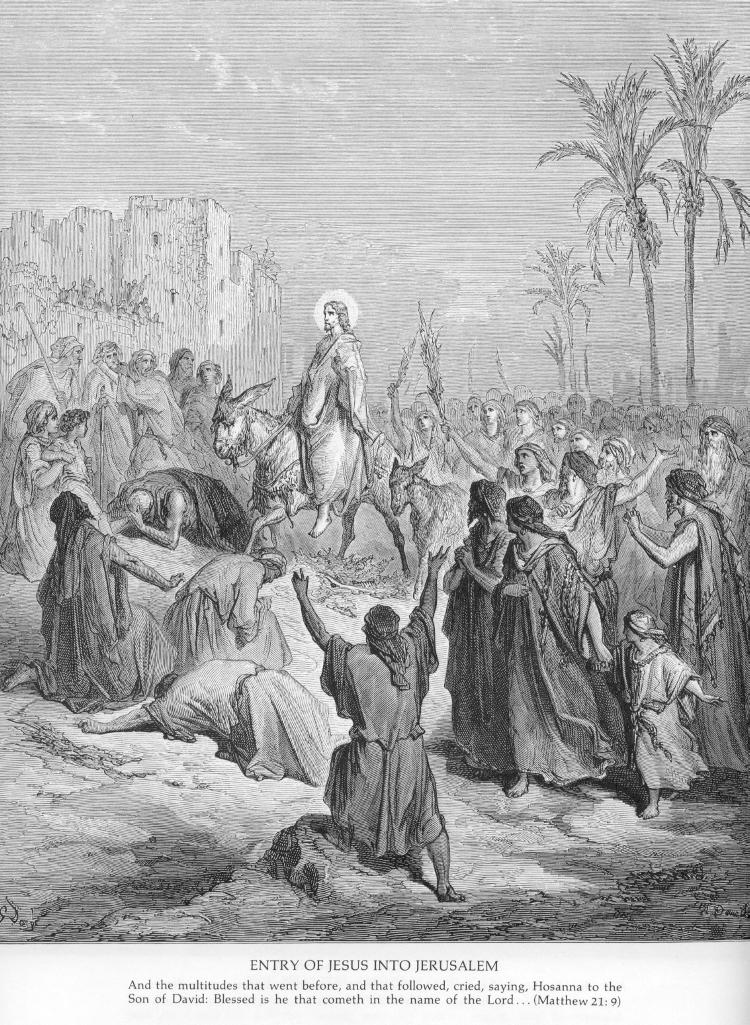
The disciples go ahead of Jesus as an advance team, the way a King's emmisaries would prepare for his visitation to a city.

They get a donkey in order to echo the Messianic message of Zecharaiah 9.

They break out the palm branches to make it super clear what they're up to and he enters the gates of Jerusalem declaring himself to be the Messianic King. But in order to complete the Psalm, as King or pilgrim celebrant, he should have gone to the horns of the altar and made sacrifice.

But what does he do? He unites the prophetic judgment with the Kingly ascent. He takes authority to himself and shuts down the sacrificial system in the temple during the week of passover!

A shocking turn of events.

(To be continued...)

Integrity Part IV: The Beginning of the End of the Boy That I Knew

On this last day, I want to return to that boy that I knew, the one with all the hang ups about who he was and what he wanted, the one I gave you several snapshots of on Monday.

I want to let you know what happened to him because, he's not that same boy anymore and he's not the same boy because he came to know that God loved him in a way that was deeper, more lasting, and more freeing than the approval he was desperately looking for from his friends, or even from himself, the approval that he had thought would bring him wholeness and integrity. Here's how it happened.

By the time that he was in ninth grade, the boy that I knew was riding pretty high in some ways and doing pretty well at winning that approval he wanted. He did very well in school, he did very well on the football field and on the basketball court and he did very well in the lunchroom. One of his chief skills in that last arena was his quick wit and sharp tongue – something that comes as little surprise to those who still know him. Particularly, this boy that I knew wasn't afraid to go anywhere with a joke, especially a sarcastic one or one that took somebody else down a few notches. In fact, that was probably his best trick.

At the school the boy that I knew attended, they didn't have morning prayer like this. Instead, they used to have a little longer chapel service once a week. This boy that I knew was one of the ones who liked to sit in the back of that chapel and make jokes about the speaker. I suppose some of them were probably even pretty funny. He sure looked like he was having fun, this boy that I knew. And at the very least, the jokes kept him safe from having to take anything seriously.

Once a year they had a whole week where a special speaker came in and they had chapel every day – which was OK as far as the boy that I knew cared, because it mixed things up a bit. And one time they even had basketball player come in.

But this time, this time. Oh my gosh, they got a real dork. He must have been 6'7”. He wore plaid short-sleeve shirts, had a ridiculous mustache and was, worse than all of that, the brother of the boy's English teacher. And he had an autoharp.

How many of you know what an autoharp is? Well, it's just about the uncoolest instrument you could possibly imagine playing in front of a group of high school kids. It's this big board with strings and keys like a piano that you strum like a guitar. What the heck is that??? But he brought his autoharp and he brought his wife, who had a bad haircut, and they sang songs together while he played his autoharp.

This was rich material for the boy that I knew. This was going to be fun, he thought, sitting in the back, sniping from the pews. It was almost too easy. He was so uncool it almost wouldn't be fun to make fun of him. Maybe we should throw tomatoes, the boy that I knew thought.

And then he started out by reading some kind of Christian children's stories – something about sled dogs. The boy that I knew was shocked. This was ridiculous. Laughable. It wasn't even entertaining. “Oh my gosh. Stop talking!” he thought. “Let me out of here, for God's sake. I'm going to go absolutely freaking insane if I have to listen to five more minutes of this!”

But as the week went on, the boy that I knew grew quieter and quieter.

Some of the kids around him started listening and discussing what the man with the autoharp was saying. Discussing it! At lunch! Why??? Some of those people were even guys he played football with. Seniors he respected and whose respect he had thought he wanted. Then the boy himself started to listen. He started to realize that he himself was getting angry, defensive. He wanted to verbally assault the man. He wanted him to leave.

The problem was that that the man with the autoharp started getting into his head, making a weird kind of sense. He began to see that the man with the autoharp probably knew that he was sitting in the back laughing and didn't even care! Didn't even care! How dare he! How dare he not care what the boy that I knew thought of him!

Then the man spoke of the love of God, and he spoke about the brotherhood and courage of those who followed God. He spoke of high school kids he knew who had traded their dead ends for real purposeful action, who were making a difference in their communities, their churches and their schools. He invited everyone to join them, to help change the world.

And suddenly the boy that I knew saw all and knew himself for what he was – sitting in the back row making jokes, tearing down his friends with biting sarcasm to advance his own pride and insecurity, picking on the weak and defenseless. And even worse, he saw himself left out of whatever it was the man in the autoharp was talking about, left out of something he suddenly wanted in on.

At the end of the week, there was a chance for people to come to the microphone and talk about the week. The boy that I knew wanted to get up and say something profound, to tell everyone that they should listen to the man with the autoharp. But when he got to the microphone, all he could say was “I'm sorry.” He couldn't say any more. He just broke down crying. But he was pretty sure everyone knew what he meant.

The life of the boy that I knew didn't change overnight, but it has never been the same either. The boy that I knew turned a corner that week.

And when I have morning prayer next semester, I'll tell you the rest of the story.